Does God Need Temples – The Truth About God, Religion and Worship
Recently, I visited many holy pilgrimage sites and places that hold spiritual significance amongst people. And all of that happened in the last 20 days. Starting from Vrindavan – the Dham of Shri Krishna, Rishikesh, which holds many stories from Shiv Vivah to Ramayan and is where the holy Ganga flows, to Ujjain, where Lord Shiva resides as Mahakaal, and then another Jyotirlinga – Omkareshwar.
I travelled to all these places in just the last 20 days, and this article points out some harsh and bitter truths through some questions that came to my mind while going through each of these places.
And somewhere along this journey, I began asking myself: Does God need temples?
Firstly,
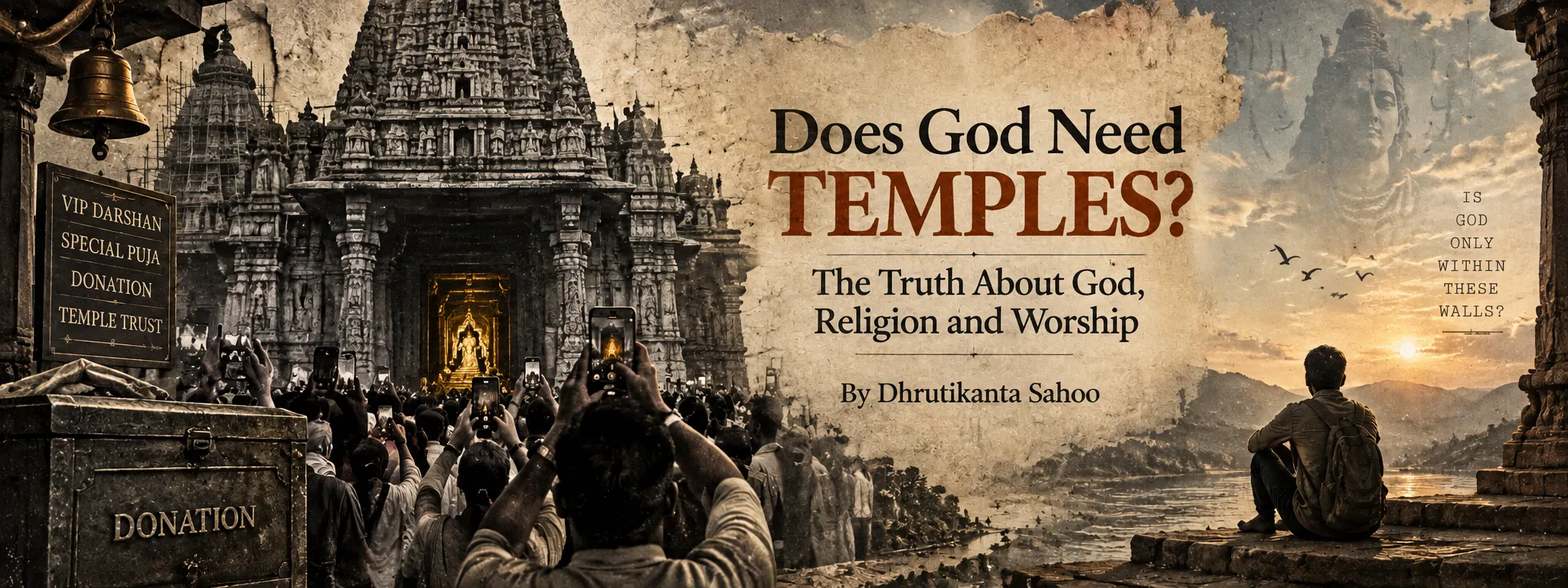
While earlier prominent temples in Vrindavan didn’t allow mobile phones and photography inside the temples, now all of that is allowed; as a result, people, instead of looking at the divine and experiencing the place of such significance, keep making videos and taking selfies for social media. But the question is WHY?
- Does your devotion need promotion to be true, or is it a feeling of showing it to the world that drives you to take pictures of wherever you go, and even if it is God, where your entire focus should be on the purest?
- Some might say that they are proud of their religion and the divine, and they share that feeling, but does God, who is supreme over everything, need such things? Didn’t He Himself say every time to BEWARE OF PRIDE?
- Well, let’s consider the feeling of being proud about your emotions for God, but wouldn’t it be much better to share it with the divine you stand in front of without the distraction of phones and snaps?
- Why does the government allow the use and entry of mobile phones inside the temple when it was prohibited earlier? Don’t the authorities know how addicted society has become to phones and social media? Don’t they know what people would do with phones in the temple?
- If the authorities believe that people should be allowed to glorify their religions, then the first question that comes is: does God really need glorification – seriously, the one who rules over everything, even our breaths?
God is glorified, or everything personified, so why would He need that promotion, as He is everything Himself? Then who benefits from such promotion or glorification?
The next weird thing that I came across at a lot of temples is the Donation or Daan Dharm culture.
Firstly, yes, Daan Dharma is mentioned in scriptures, but it’s mostly portrayed in a wrong way as it is done nowadays. Daana is mostly done for those who can’t afford a living for themselves or those who are in need. And they can be anyone, a dog, an animal, a tree or plant, or a poor person. And another layer of Daan Dharma is that Daana is not always in the form of money or material. You might not afford to treat someone who might be going through some serious health issue, but you can still feel their cry for life just by putting yourself in their place and by praying to God to take care of them – and even that is Daana, perhaps in a much purer way.
But unlike this, Daana nowadays is being commercialised by people, pandits and even temples, where donations are taken for VIP Darshans, rituals, skipping queues at temples, and various internal things that the temple needs, like security, construction, taking care of all the processes the temple administration needs, etc.
But the question is, the one who owns all the resources, the one who owns the air, the soil, the atoms, and the womb from which every particle took birth –
Does God need any donation? What would He do with that money? Does money even work in His realm? What would He buy when everything is His?
The next question is, does God need Gold, ornaments, or even huge Temples and corridors?
Does God need huge corridors to glorify Himself so that more and more people come to Him? Or have God and true saints always said that the true seekers will eventually reach the one who holds the truth, for truth needs no promotion?
So God neither needs huge temples, nor ornaments, nor corridors, nor any promotion for His Glorification. Then who needs it? Who benefits from such promotions and glorification?
Truth About God: Does God Need Temples?
1. Where He resides -
If God only resides in temples, Jyotirlingas and His place of birth, then why didn’t Gautama Buddha, Prahalada, Meerabai and other true disciples mentioned in our holy scriptures just look for a physical form or a temple? Why did they keep walking and searching for God?
Doesn’t that mean that God is above what we have always been taught about Him?
2. History of interpretation of God -
Well, if we truly follow our scriptures, the oldest origin where Gods were mentioned for the very first time were the scriptures like Puranas and Vedas. It was around -1500 BCE and -500 BCE when Deities had poetic descriptions and mantras, but there were no physical temples, idols, or wall paintings representing figures like Hanuman or Parvati in the forms seen today. The depictions mostly explained god as energies arranged, shaping and expanding to carry out different things in the cosmos. That’s why, at that time worship focused on Yajnas (fire rituals) and natural, abstract forces—Agni (fire), Indra (thunder/rain), Varuna (water/cosmic order) etc.
Later on around the 3rd to 12th Century of Common Era, kings and emperors built iconography derived from compiling and decoding verses from Puranas and other scriptures.
This was the time when narratives around the Trinity (Brahma, Vishnu, Shiva), the Goddess (Durga/Parvati), and avatars like Rama and Krishna flourished.
But even then these depictions existed primarily as temple stone sculptures, bronze castings (such as Chola bronzes), and cave frescoes (like Ajanta and Ellora), not as mass-produced paintings.
And that’s why if we compare the sculptures on the walls of historical monuments and temples, and even idols built in historical temples, their shapes, structures and physical depictions differ a lot from what we see today on the internet. Initially they were still shapes showing deformed shapes depicting energy and capabilities flow freely with no bodily limitations.
But then came the late 1800s and 1900s when calendar culture emerged in India and gods as we see them now on paintings, modern sculptures, stories, printed translations of scriptures, films and other ways evolved, giving gods specific faces, naturalistic skin tones, flowing silk garments, and realistic human proportions.
So if we see, the very origin of God as mentioned in Puranas were in the form of sounds or mantras, cosmic forces that command how life and world is arranged and in the forms of how energy expands, contracts and spreads to carry out different things and allow life to sustain.
3. What was the religion of God?
Well, perhaps God had no religion; instead, He was the religion Himself.
And more than that, just imagine: did the word religion come first or God?
It’s simple. God is the beginning and the end, while the word and meaning of “religion” came later, which will again fade away when languages in the future change, or humanity itself gets erased to begin again. But what will remain is the meaning, intention, and feeling behind the word God and the path He followed – that is a path of pure intentions, calmness, compassion, love, and equanimity for all.
The bottom line is that today, also, beyond the word religion, God holds the same essence in every practice, which we have lost the ability to perceive, and we have divided ourselves.
4. Then why are there religions?
Just like every individual is allowed to ask and perceive reality in whichever way one wants, just like the different questions to know the ultimate truth might have made individuals look for their answers in different ways. And those who gave it all, going beyond everything, found different ways and disciplines to realize the ultimate truth, and they named those paths with something that we today call Religions, while the meaning behind all was the same Ultimate Truth.
It’s just like someone with a simple microscope asking what’s the ultimate unit of the human body, someone with much stronger equipment asking what’s the ultimate unit of an object, and as time passes and technology becomes even more advanced, then when someone asks what’s beyond atoms and subatomic particles – all these open up different paths of study like biology, physics, and quantum physics, while all asking the same question: what is the ultimate truth.
Just like that, at different times, different people with different questions and approaches looked for the ultimate truth of existence, which gave birth to different disciplines, which we call religion today. But we must not forget that in the end, all began and ended with the same nameless, faceless ultimate truth, holding the same essence of purity, unity, love, compassion, and equanimity.
And perhaps this brings me back to the question I started with: does God need temples?
So next time anyone tries to divide you in the name of different Gods, paths and religions, try to question it, remember what it all began from, if God would ever see anyone different, and then, as you see the truth, be a part of every festival together, enjoy the love being shared beyond religions and so-called differences, accept it all or actually be accepted, and love, God, and purity will flourish in your heart like never before.
This journey was also described in my earlier article, The Search for God and the Meaning of Life – An Experience Lived.