Why Some People Become Aware While Dreaming – The Science and Spirituality of Lucid Dreaming
Want to listen to the article? Hit the play button and enjoy the article in a podcast style.
Themes – Science & Mind, Awareness, Consciousness, Hindu Philosophy, Vedanta, Dream Science, Awareness of Awareness, Lucid Dreaming, Spiritual Philosophy
Have you ever wondered why sometimes, even while in sleep, some people become aware of the fact that they are dreaming? What part of the brain, even when in sleep, makes you aware of it?
One of the classic examples where people encounter such a state of awareness—of being able to observe themselves dreaming—is when, in a dream, they come across some ghost or an unholy spirit. This is where they become aware that in their dream they must take God’s name to free themselves from the spirit in the dream.
I myself have experienced numerous such instances, when I became aware that I was dreaming, and only God’s name revived me from the paralyzed state of sleep and dreaming. In one of my articles named Spiritual Paranoia – When Meditation Gets Too Deep, I have shared one such instance where I lost track of reality—the barrier between the waking state and the dream state—as I kept waking up from dreams into dreams, which lasted for hours before I finally woke up, with a disoriented sense of reality, still thinking if it was real or if I was still dreaming.
But if we go into the studies that have been done around this and the science behind it, it’s basically termed Lucid Dreaming—a metaphysical state of awareness when one becomes aware of their dreams.
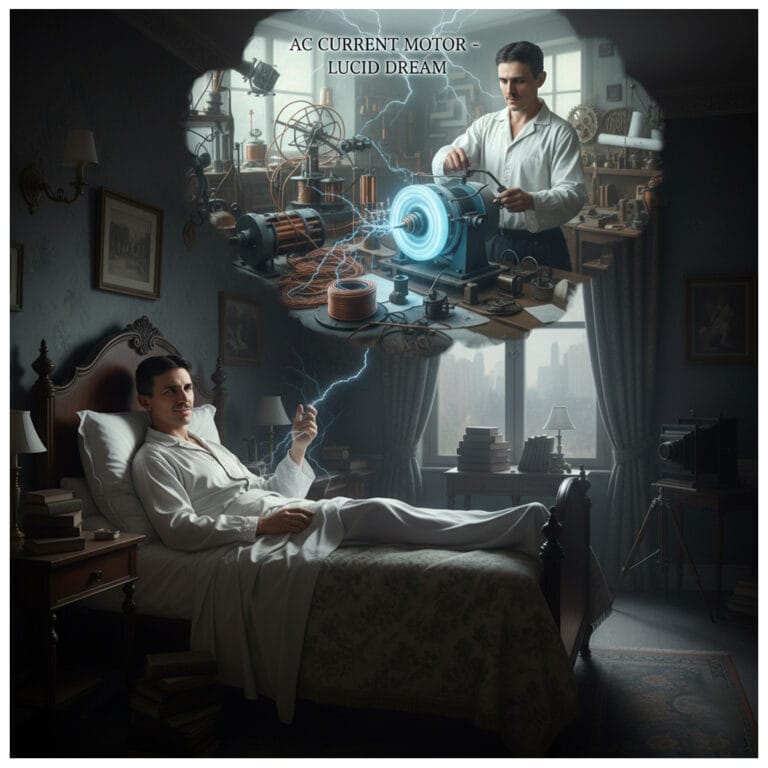
Scientists like Thomas Alva Edison, Nikola Tesla, and filmmakers like Christopher Nolan have publicly admitted that lucid dreaming has helped them to find answers to their seeking. Christopher Nolan even made a movie—Inception—based on the same metaphysical concept of lucid dreaming. He even admitted that he got the plot and a few ideas for the film through lucid dreaming.
But the question is, even when someone is sleeping, what makes them realize that they are dreaming? Which part of the being wakes up or sees this difference? And does the brain have any knowledge of how to differentiate between a dream and the reality that we experience in the waking state?
Well, let’s find the answers one by one.
Firstly, the weird fact about the brain is that, from the brain’s perspective, it actually sees no difference in dreaming and waking experiences. It perceives everything as electrical impulses, neural firing patterns, and sensory images forming in it—irrespective of whether it’s a dream or waking experience. By this, the brain generates and makes it feel equally real, both when producing sensory images for the real world or for the dream world.
However, the prefrontal cortex region of the brain—the part responsible for reasoning, logic, and self-awareness—is less active during sleep and dreaming. This is why, even while dreaming, we feel the emotions and illogical incidents with the same depth as we feel for real-world experiences.
So, in short, even when one becomes aware of a dream, it’s not because the brain distinguishes it; instead, it happens when the prefrontal cortex region of the brain becomes active or partially active, allowing you to put logical questions to the dream—where you might be fighting a dragon or flying, which, as per logic, is impossible.
Then, if it’s not the brain, what makes people know that they are dreaming?
Firstly, this itself is called Lucid Dreaming—when one realizes within the dream that it’s a dream. And the explanation and reasons that we have for it are that somehow the awareness of awareness—or in other words, becoming aware of the fact that you’re in a dream—gets reactivated in sleep, allowing you to question what’s happening and find logic in the dream.
It’s like when you’re dreaming, you experience and feel the dream to be real, and in the dream, you’re aware of all that goes on around you. But imagine, while having a dream, the awareness that you hold in the waking state—that which has knowledge of logic and reasoning—becomes active during sleep. This awareness will now allow you to see the version of yourself who is in the dream.

It’s like a version of you that’s more aware starts to see another version of yourself involved in the dream, where that version is also aware in the dream. And because of this, the more logical version of you becomes able to identify that it’s a dream, while within the same being (yourself), your own version keeps experiencing the dream like a real-life experience. This state is said to be Awareness of Awareness.
My Personal Experience
Though I have come across many such instances where I became aware of my dream within dreams, the dream that I had last night inspired me to write this article.
In the dream—though not exactly—but I still remember I was in a very holy environment, and somehow, like poetry, words started flowing in the dream. But this time, it wasn’t a normal poem or quote; the meaning behind those words felt divine, as if the words were coming directly from a goddess.
I vividly remember that they weren’t words that I heard from her; instead, she spoke by invoking the feelings that the words hid behind them, and somehow I felt it deeply. I felt it to be so divine, filled with truth and wisdom, that in the dream, I thought of turning them into words which I could later keep as a note to remind me of. But I found it really difficult to convert them into words, and that’s when I somehow became aware of the fact that it was a holy dream.
Firstly, the weird fact that it wasn’t words that invoked the holy feeling—instead, it was the opposite—where the pure feeling was kind of breathed into me by the goddess, and I was trying to take a note of it—made it a bit illogical, making me doubt that this must be a dream.
Further, as I tried to portray her message in words, I realized that by the time I was able to write the middle part of it, I had already forgotten the beginning. And similarly, by the time I thought of the ending, I had lost the middle and the beginning. The words came in patches, with constant lag, making it difficult to even memorize in the dream.
While I was eager to wake up and write it down, at the same time, in the dream, I was aware that if I woke up in the middle of it without memorizing it completely, I would surely forget the lines. Hence, after trying hard a few more times, when I was completely convinced that I had a decent memory of the lines—the part of awareness that knew I was doing all this in the dream—allowed me to wake up and write it down. And I exactly followed its command, woke up as soon as that awareness told me to, and then wrote the message down.
The message was:
“A body and mind without true awareness is like a body unattended—that keeps playing the information it has recorded or experienced in loop. On the other hand, being aware gives true life to the body, the mind, and the being—where it knows what it’s doing and at the same time remains detached to such a level that it forgets its own spoken words—and only remains aware of the true present. It remains so aligned with the present that no past, no already spoken words, or thought of any future appears to it. For it, only true awareness where knowing one thing with its entirety remains, and that awareness becomes the presence and present itself.”
While the words might seem a bit fragmented, this was the gist and meaning of the divine feeling that was invoked within me.
Although I felt relieved as I had a decent memory of the lines from the dream, it left a deep question within me—that is, which part of me became aware of the dream and started seeing it from above? And further, which part of me was it that kept guiding me to remain in the dream until I memorized the lines before ending it and waking up, fearing that if I didn’t do so, I wouldn’t remember the dream? Lastly, how in the world, just after it felt convinced enough, did it swiftly allow—or perhaps suggest—me to wake up?
These questions led me to do all the research that I have put into this article.
Philosophical Interpretation of Lucid Dreaming
In philosophy, it’s said that both dream and waking states are experiences within consciousness, and that is how we get to experience both of them.
While the difference comes with logic and degree of coherence—that is, dreams dissolve quicker, while waking experience sustains longer through the shared and collective logic of the world.
But, in the end, the witnessing self—the “I” that observes both the logical world of material reality and the non-physical world of dreams—is the same for both of them.
Spiritual Insights of Lucid Dreaming
The philosophical reasoning resonates with the spiritual insights found in Hindu scriptures. Moreover, the scriptures take it further deep, saying both waking and dreaming feel real only as long as they last.
Hindu texts say that the material world which we feel to be real and the non-physical realm of dreams are both projections in the brain, carried by chemicals and electrical signals through the body, while the witness of both—the unchanging—is real amongst all.
And just like modern-day philosophy says, the Hindu Vedanta has told this since the beginning of humanity—that both the material world reflected in the brain and the non-material world of dreams are dreams within Consciousness—and only the knower of all is real.
Conclusion and Personal Verdict
To sum up—with the scientific explanation, philosophical reasoning, and spiritual insights, along with my own exploration and experience—I would say that perhaps, within ourselves, there are layers of awareness, where some are higher, with higher perception and awareness, while some are lower, with less awareness. And as we keep aligning with the higher awareness or the higher self within us, we start to see the lower ones like a movie, where our simpler versions are living less-aware lives.






You’ve created something that resonates on many levels — intellectually, emotionally, and even spiritually.